Personnel

These are the U.S. Army ranks authorized for use today and their equivalent NATO designations. Although no living officer currently holds the rank of General of the Army, it is still authorized by Congress for use in wartime.
Commissioned officersedit
There are several paths to becoming a commissioned officer including the United States Military Academy, Reserve Officers' Training Corps, Officer Candidate School, and Direct commissioning. Regardless of which road an officer takes, the insignia are the same. Certain professions including physicians, pharmacists, nurses, lawyers and chaplains are commissioned directly into the Army.
Most army commissioned officers (those who are generalists) are promoted based on an "up or out" system. The Defense Officer Personnel Management Act of 1980 establishes rules for timing of promotions and limits the number of officers that can serve at any given time.
Army regulations call for addressing all personnel with the rank of general as "General (last name)" regardless of the number of stars. Likewise, both colonels and lieutenant colonels are addressed as "Colonel (last name)" and first and second lieutenants as "Lieutenant (last name)".
| US DoD Pay Grade | O-1 | O-2 | O-3 | O-4 | O-5 | O-6 | O-7 | O-8 | O-9 | O-10 | Special grade | |
|---|---|---|---|---|---|---|---|---|---|---|---|---|
| NATO Code | OF-1 | OF-2 | OF-3 | OF-4 | OF-5 | OF-6 | OF-7 | OF-8 | OF-9 | OF-10 | ||
| Insignia | 
|

|

|

|

|

|

|

|

|

|

| |
| Service Green Uniform Insignia |

|

|
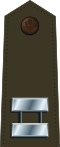
|
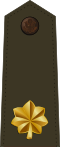
|

|

|

|

|

|
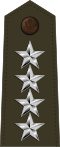
|

| |
| Title | Second lieutenant | First lieutenant | Captain | Major | Lieutenant colonel | Colonel | Brigadier general | Major general | Lieutenant general | General | General of the Army | |
| Abbreviation | 2LT | 1LT | CPT | MAJ | LTC | COL | BG | MG | LTG | GEN | GA | |
Warrant officersedit
Warrant officers are single track, specialty officers with subject matter expertise in a particular area. They are initially appointed as warrant officers (in the rank of WO1) by the secretary of the Army, but receive their commission upon promotion to chief warrant officer two (CW2).
By regulation, warrant officers are addressed as "Mr. (last name)" or "Ms. (last name)" by senior officers and as "sir" or "ma'am" by all enlisted personnel. However, many personnel address warrant officers as "Chief (last name)" within their units regardless of rank.
| US DoD Pay Grade | W-1 | W-2 | W-3 | W-4 | W-5 |
|---|---|---|---|---|---|
| NATO Code | WO-1 | WO-2 | WO-3 | WO-4 | WO-5 |
| Insignia | 
|

|

|

|

|
| Title | Warrant officer 1 | Chief warrant officer 2 | Chief warrant officer 3 | Chief warrant officer 4 | Chief warrant officer 5 |
| Abbreviation | WO1 | CW2 | CWO | CW4 | CW5 |
Enlisted personneledit
Sergeants and corporals are referred to as NCOs, short for non-commissioned officers. This distinguishes corporals from the more numerous specialists who have the same pay grade, but do not exercise leadership responsibilities.
Privates and privates first class (E3) are addressed as "Private (last name)", specialists as "Specialist (last name)", corporals as "Corporal (last name)" and sergeants, staff sergeants, sergeants first class and master sergeants all as "Sergeant (last name)". First sergeants are addressed as "First Sergeant (last name)" and sergeants major and command sergeants major are addressed as "Sergeant Major (last name)".
| U.S. DoD Pay grade | E-1 | E-2 | E-3 | E-4 | E-5 | E-6 | E-7 | E-8 | E-9 | |||||
|---|---|---|---|---|---|---|---|---|---|---|---|---|---|---|
| NATO Code | OR-1 | OR-2 | OR-3 | OR-4 | OR-5 | OR-6 | OR-7 | OR-8 | OR-9 | |||||
| Service Green Uniform Insignia |
No insignia | 
|

|

|

|

|

|

|

|

|

|

|

|

|
| Title | Private | Private |
Private first class |
Specialist | Corporal | Sergeant | Staff Sergeant |
Sergeant first class |
Master sergeant |
First sergeant |
Sergeant major |
Command sergeant major |
Sergeant Major of the Army |
Senior Enlisted Advisor to the Chairman |
| Abbreviation | PV1 ¹ | PV2 ¹ | PFC | SPC ² | CPL | SGT | SSG | SFC | MSG | 1SG | SGM | CSM | SMA | SEAC |
| ¹ PVT is also used as an abbreviation for both private ranks when pay grade need not be distinguished. ² SP4 is sometimes encountered instead of SPC for specialist. This is a holdover from when there were additional specialist ranks at pay grades E-5 to E-7. | ||||||||||||||
Trainingedit
Training in the U.S. Army is generally divided into two categories – individual and collective. Because of COVID-19 precautions, the first two weeks of basic training — not including processing & out-processing — incorporate social distancing and indoor desk-oriented training. Once the recruits have tested negative for COVID-19 for two weeks, the remaining 8 weeks follow the traditional activities for most recruits, followed by Advanced Individualized Training (AIT) where they receive training for their military occupational specialties (MOS). Some individual's MOSs range anywhere from 14 to 20 weeks of One Station Unit Training (OSUT), which combines Basic Training and AIT. The length of AIT school varies by the MOS. The length of time spent in AIT depends on the MOS of the soldier. Certain highly technical MOS training requires many months (e.g., foreign language translators). Depending on the needs of the army, Basic Combat Training for combat arms soldiers is conducted at a number of locations, but two of the longest-running are the Armor School and the Infantry School, both at Fort Benning, Georgia. Sergeant Major of the Army Dailey notes that an infantrymen's pilot program for One Station Unit Training (OSUT) extends 8 weeks beyond Basic Training and AIT, to 22 weeks. The pilot, designed to boost infantry readiness ended December 2018. The new Infantry OSUT covered the M240 machine gun as well as the M249 squad automatic weapon. The redesigned Infantry OSUT started in 2019. Depending on the result of the 2018 pilot, OSUTs could also extend training in other combat arms beyond the infantry. One Station Unit Training will be extended to 22 weeks for Armor by Fiscal Year 2021. Additional OSUTs are expanding to Cavalry, Engineer, and Military Police (MP) in the succeeding Fiscal Years.
A new training assignment for junior officers was instituted, that they serve as platoon leaders for Basic Combat Training (BCT) platoons. These lieutenants will assume many of the administrative, logistical, and day-to-day tasks formerly performed by the drill sergeants of those platoons and are expected to "lead, train, and assist with maintaining and enhancing the morale, welfare and readiness" of the drill sergeants and their BCT platoons. These lieutenants are also expected to stem any inappropriate behaviors they witness in their platoons, to free up the drill sergeants for training.
The United States Army Combat Fitness Test (ACFT) is being introduced into the Army, beginning with 60 battalions spread throughout the Army. The test is the same for all soldiers, men or women. It will take an hour to complete, including resting periods. The ACFT supersedes the Army physical fitness test (APFT), as being more relevant to survival in combat. Six events were determined to better predict which muscle groups of the body were adequately conditioned for combat actions: three deadlifts, a standing power throw of a ten-pound medicine ball, hand-release pushups (which replace the traditional pushup), a sprint/drag/carry 250 yard event, three pull-ups with leg tucks (one needed to pass), a mandatory rest period, and a two-mile run. Eventually (by October 2020) all soldiers from all three components (Active Army, Reserve, and National guard) will be subject to this test. The ACFT will test all soldiers in basic training by October 2020. The ACFT becomes the official test of record 1 October 2020; before that day every Army unit is required to complete a diagnostic ACFT (All Soldiers with valid APFT scores can use them until March 2022). The ACFT movements directly translate to movements on the battlefield.
Following their basic and advanced training at the individual-level, soldiers may choose to continue their training and apply for an "additional skill identifier" (ASI). The ASI allows the army to take a wide-ranging MOS and focus it into a more specific MOS. For example, a combat medic, whose duties are to provide pre-hospital emergency treatment, may receive ASI training to become a cardiovascular specialist, a dialysis specialist or even a licensed practical nurse. For commissioned officers, training includes pre-commissioning training, known as Basic Officer Leader Course A, either at USMA or via ROTC, or by completing OCS. After commissioning, officers undergo branch specific training at the Basic Officer Leaders Course B, (formerly called Officer Basic Course), which varies in time and location according to their future assignments. Officers will continue to attend standardized training at different stages of their career.
Collective training at the unit level takes place at the unit's assigned station, but the most intensive training at higher echelons is conducted at the three combat training centers (CTC); the National Training Center (NTC) at Fort Irwin, California, the Joint Readiness Training Center (JRTC) at Fort Polk, Louisiana and the Joint Multinational Training Center (JMRC) at the Hohenfels Training Area in Hohenfels and Grafenwöhr, Germany. ARFORGEN is the Army Force Generation process approved in 2006 to meet the need to continuously replenish forces for deployment, at unit level and for other echelons as required by the mission. Individual-level replenishment still requires training at a unit level, which is conducted at the continental U.S. (CONUS) replacement center (CRC) at Fort Bliss, in New Mexico and Texas before their individual deployment.
Chief of Staff Milley notes that the Army is suboptimized for training in cold-weather regions, jungles, mountains, or urban areas where in contrast the Army does well when training for deserts or rolling terrain.:minute 1:26:00 Post 9/11, Army unit-level training was for counter-insurgency (COIN); by 2014–2017, training had shifted to decisive action training.

Comments
Post a Comment