Equipment
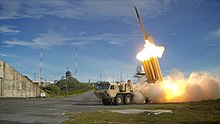
The chief of staff of the Army has identified six modernization priorities, in order: artillery, ground vehicles, aircraft, network, air/missile defense, and soldier lethality.
Weaponsedit
Individual weaponsedit
The army employs various individual weapons to provide light firepower at short ranges. The most common weapon type used by the army is the M4 carbine, a compact variant of the M16 rifle, along with the 7.62×51mm variant of the FN SCAR for Army Rangers. The primary sidearm in the U.S. Army is the 9 mm M9 pistol; the M11 pistol is also used. Both handguns are to be replaced by the M17 through the Modular Handgun System program. Soldiers are also equipped with various hand grenades, such as the M67 fragmentation grenade and M18 smoke grenade.
Many units are supplemented with a variety of specialized weapons, including the M249 SAW (Squad Automatic Weapon), to provide suppressive fire at the squad level. Indirect fire is provided by the M320 grenade launcher. The M1014 Joint Service Combat Shotgun or the Mossberg 590 Shotgun are used for door breaching and close-quarters combat. The M14EBR is used by designated marksmen. Snipers use the M107 Long Range Sniper Rifle, the M2010 Enhanced Sniper Rifle and the M110 Semi-Automatic Sniper Rifle.
Crew-served weaponsedit
The army employs various crew-served weapons to provide heavy firepower at ranges exceeding that of individual weapons.
The M240 is the U.S. Army's standard Medium Machine Gun. The M2 heavy machine gun is generally used as a vehicle-mounted machine gun. In the same way, the 40 mm MK 19 grenade machine gun is mainly used by motorized units.
The U.S. Army uses three types of mortar for indirect fire support when heavier artillery may not be appropriate or available. The smallest of these is the 60 mm M224, normally assigned at the infantry company level. At the next higher echelon, infantry battalions are typically supported by a section of 81 mm M252 mortars. The largest mortar in the army's inventory is the 120 mm M120/M121, usually employed by mechanized units.
Fire support for light infantry units is provided by towed howitzers, including the 105 mm M119A1 and the 155 mm M777.
The U.S. Army utilizes a variety of direct-fire rockets and missiles to provide infantry with an Anti-Armor Capability. The AT4 is an unguided projectile that can destroy armor and bunkers at ranges up to 500 meters. The FIM-92 Stinger is a shoulder-launched, heat seeking anti-aircraft missile. The FGM-148 Javelin and BGM-71 TOW are anti-tank guided missiles.
Vehiclesedit
U.S. Army doctrine puts a premium on mechanized warfare. It fields the highest vehicle-to-soldier ratio in the world as of 2009. The army's most common vehicle is the High Mobility Multipurpose Wheeled Vehicle (HMMWV), commonly called the Humvee, which is capable of serving as a cargo/troop carrier, weapons platform and ambulance, among many other roles. While they operate a wide variety of combat support vehicles, one of the most common types centers on the family of HEMTT vehicles. The M1A2 Abrams is the army's main battle tank, while the M2A3 Bradley is the standard infantry fighting vehicle. Other vehicles include the Stryker, the M113 armored personnel carrier and multiple types of Mine Resistant Ambush Protected (MRAP) vehicles.
The U.S. Army's principal artillery weapons are the M109A6 Paladin self-propelled howitzer and the M270 Multiple Launch Rocket System (MLRS), both mounted on tracked platforms and assigned to heavy mechanized units.
While the United States Army Aviation Branch operates a few fixed-wing aircraft, it mainly operates several types of rotary-wing aircraft. These include the AH-64 Apache attack helicopter, the UH-60 Black Hawk utility tactical transport helicopter and the CH-47 Chinook heavy-lift transport helicopter. Restructuring plans call for reduction of 750 aircraft and from 7 to 4 types.
Under the Johnson-McConnell agreement of 1966, the Army agreed to limit its fixed-wing aviation role to administrative mission support (light unarmed aircraft which cannot operate from forward positions). For UAVs, the Army is deploying at least one company of drone MQ-1C Gray Eagles to each Active Army division.
Uniformsedit
The Army Combat Uniform (ACU) currently features a camouflage pattern known as Operational Camouflage Pattern (OCP); OCP replaced a pixel-based pattern known as Universal Camouflage Pattern (UCP) in 2019.
On 11 November 2018, the Army announced a new version of 'Army Greens' based on uniforms worn during World War II will become the standard garrison service uniform. The blue Army Service Uniform will remain as the dress uniform. The Army Greens are projected to be first fielded in summer of 2020.
Beretsedit
The beret flash of enlisted personnel displays their distinctive unit insignia (shown above). The U.S. Army's black beret is no longer worn with the ACU for garrison duty, having been permanently replaced with the patrol cap. After years of complaints that it was not suited well for most work conditions, Army chief of staff General Martin Dempsey eliminated it for wear with the ACU in June 2011. Soldiers who are currently in a unit in jump status still wear berets, whether the wearer is parachute-qualified or not (maroon beret), while members of Security Force Assistance Brigades (SFABs) wear brown berets. Members of the 75th Ranger Regiment and the Airborne and Ranger Training Brigade (tan beret) and Special Forces (rifle green beret) may wear it with the Army Service Uniform for non-ceremonial functions. Unit commanders may still direct the wear of patrol caps in these units in training environments or motor pools.
Tentsedit
The Army has relied heavily on tents to provide the various facilities needed while on deployment (Force Provider Expeditionary (FPE)).:p.146 The most common tent uses for the military are as temporary barracks (sleeping quarters), DFAC buildings (dining facilities), forward operating bases (FOBs), after action review (AAR), tactical operations center (TOC), morale, welfare and recreation (MWR) facilities, as well as security checkpoints. Furthermore, most of these tents are set up and operated through the support of Natick Soldier Systems Center. Each FPE contains billeting, latrines, showers, laundry and kitchen facilities for 50–150 Soldiers,:p.146 and is stored in Army Prepositioned Stocks 1, 2, 4 and 5. This provisioning allows combatant commanders to position soldiers as required in their Area of Responsibility, within 24 to 48 hours.
The U.S. Army is beginning to use a more modern tent called the deployable rapid assembly shelter (DRASH). In 2008, DRASH became part of the Army's Standard Integrated Command Post System.

Comments
Post a Comment